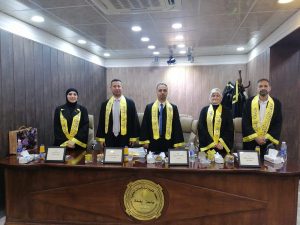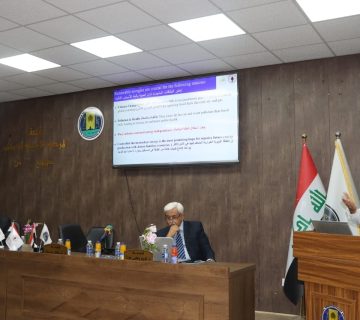

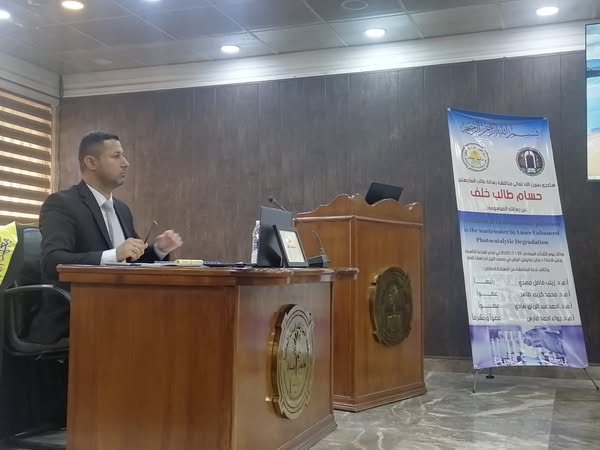
A master’s thesis entitled “Treatment of Environmental pollution in the wastewater by Laser Enhanced Photocatalytic Degradation” was discussed at the Institute of Laser for Postgraduate Studies at University of Baghdad. The thesis, presented by student Hussam Talib Khalaf and supervised by Dr. Rawaa A. Faris Al-Saadi, aims to evaluate the removal efficiency of methylene blue dye using different laser wavelengths in the presence of multi-walled carbon nanotubes (MWCNTs), compare the effect of these light sources on the dye removal rate, and determine the optimal wavelength to achieve the highest removal efficiency in their presence.
The multi-walled carbon nanotubes used in this work were investigated using energy dispersive X-ray spectroscopy (EDX), Fourier transform infrared spectroscopy (FTIR), field emission scanning electron microscopy (FESEM), and UV-Visible absorption spectroscopy.
The particle sizes of the multi-walled carbon nanotubes ranged from 46.65 to 92.47 nm; after the reaction, the size range was between 50.06 and 74.81 nm. The chemical composition shows a relatively high percentage of carbon (91.6%) and very low percentages of oxygen (O), iron (Fe), aluminum (Al), and copper (Cu) (4.7%, 1.3%, 2.3%, and 0.2%, respectively). It is also observed that when the dose of multi-walled carbon nanotubes was increased from 0.075 to 0.125 g, the removal rate increased, with the 632 nm wavelength increasing from 63% to 80.9%, with sunlight increasing from 71.5% to 74.23%, with 532 nm wavelength increasing from 38.7% to 61.61%, and with 473 nm wavelength increasing from 27.8% to 59.49%. Both the 632 nm diode laser and sunlight are more efficient in removing methylene blue (MB) dye from aqueous solution, while the results show that the 532 and 473 nm lasers are less efficient and have a low dye removal effect.
Kinematic analysis of the reaction shows that the removal process in the presence of a 632 nm laser and low nanoparticle doses follows a pseudo-first-order model. As the multi-walled carbon particle dose increases to 0.125 g, the reaction follows a pseudo-second-order kinetic equation. This study demonstrates that the 632 nm laser is more efficient than sunlight and enhances the removal of methylene blue dye.
This study confirms the effectiveness of using multi-walled carbon nanotubes as catalysts for removing dye contaminants from water. It also highlights the importance of selecting the appropriate light source wavelength to achieve optimal removal efficiency.